

How to Generate High-Quality B2B Leads for Your Technology Business
Why B2B Lead Generation for Technology Companies Demands a Different Approach
B2b lead generation for technology companies requires a strategic approach that accounts for long sales cycles, complex buying committees, and the growing preference for self-directed research. Success depends on building trust through valuable content, optimizing for high-intent buyers, and aligning marketing efforts with measurable revenue outcomes.
Key strategies for effective B2B tech lead generation include:
Content marketing custom to each stage of the buyer's journey
Account-Based Marketing (ABM) for high-value target accounts
Intent data to identify prospects actively researching solutions
Lead nurturing workflows that educate and build relationships
Marketing automation to personalize outreach at scale
Clear metrics like MQL-to-SAL conversion and pipeline contribution
Technology companies face unique challenges when it comes to generating qualified leads. Unlike consumer products, tech solutions are often intangible and require significant education. The buying process involves multiple stakeholders—often more than five people according to Gartner—and can stretch over a year or more. Meanwhile, 87% of customers begin their product research online, often long before they're ready to talk to sales.
This means our marketing must do more than just capture contact information. It needs to build awareness, establish credibility, demonstrate value, and nurture relationships across a complex journey. The stakes are high: low-quality leads waste your team's time and budget, while competitors who understand this landscape will win the deals you miss.
The good news is that with the right systems in place, you can attract high-intent buyers, shorten your sales cycle, and build a predictable pipeline. This requires a clear understanding of your ideal customer, a mix of inbound and outbound tactics, and a commitment to measuring what matters.
I'm Sam McKinney, founder of McKinney Creative Ventures, and I've spent over 15 years helping businesses build smarter marketing systems that generate consistent growth. My work in b2b lead generation for technology companies focuses on creating streamlined, automated processes that connect strategy to revenue—helping tech businesses turn fragmented marketing efforts into sustainable lead generation engines.
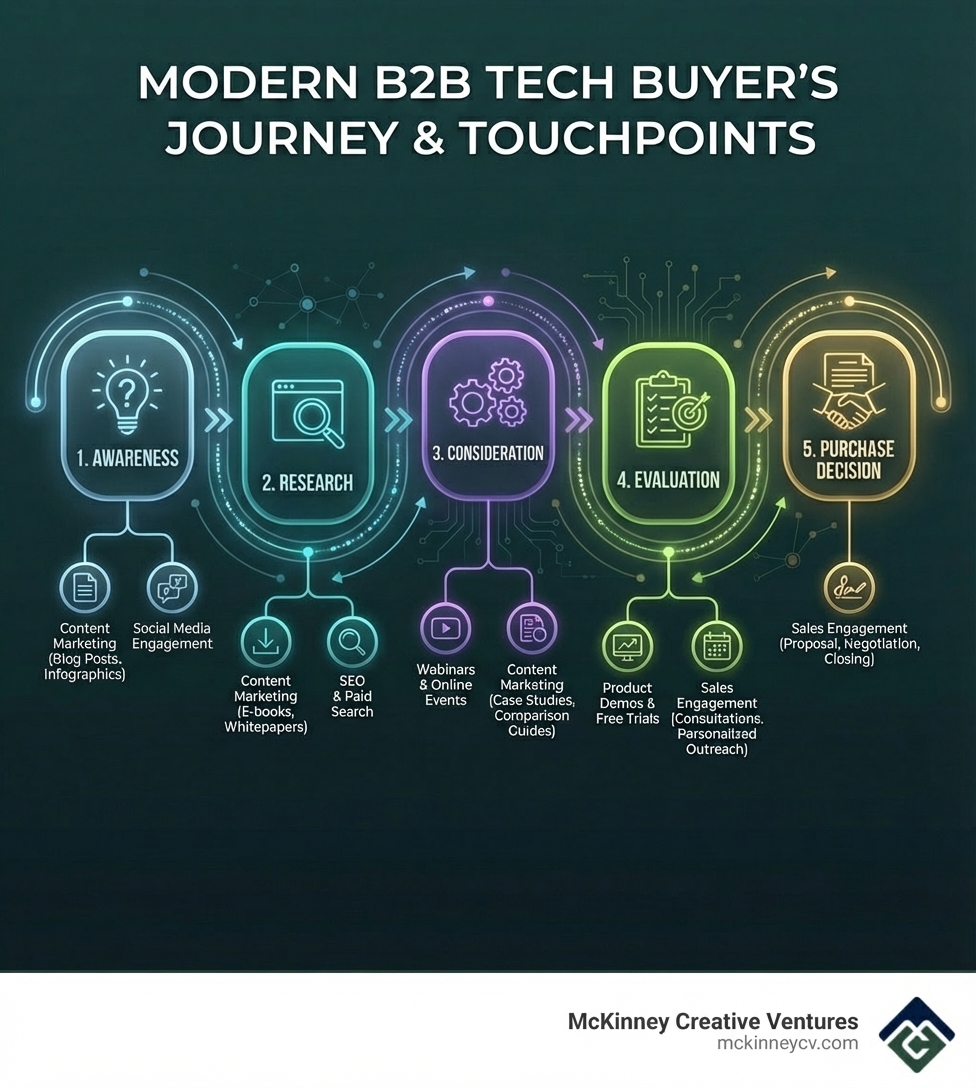
Understanding the Unique Landscape for Tech Companies
The technology sector is growing at a breakneck pace, but this growth also brings intense competition. For companies offering software, IT services, or other tech solutions in the East Metro Twin Cities and St. Croix Valley, generating leads is inherently different from other industries. Our products are often intangible, requiring us to educate potential clients on complex concepts and demonstrate their real-world value.
Consider that 87% of customers begin their product searches online. They are actively researching, comparing solutions, and forming opinions long before they ever engage with a sales representative. This rise of the "self-service buyer" means our digital presence must be robust and informative, providing answers and building trust without a direct sales pitch.
Furthermore, B2B tech purchases involve extended sales cycles, sometimes lasting over a year. The buying committee is typically large, often including more than five people, each with different priorities and concerns. We need to reach specific roles, from CIOs to project managers, and keep our solutions in front of them consistently throughout their evaluation process. Standing out in this crowded market requires more than just a good product; it demands a strategic, consistent, and trustworthy approach to lead generation.
Defining Your Ideal Customer
Before we even think about tactics, we must deeply understand who we are trying to reach. This starts with defining our Ideal Customer Profile (ICP). An ICP isn't just about company size or industry; it includes the specific challenges they face, their growth goals, and their technological maturity. Once we have an ICP, we can create detailed buyer personas.
Buyer personas are semi-fictional representations of our ideal customers, based on data and educated guesswork. For a technology company, these personas might include roles like an IT Director, a Head of Product, or a Business Operations Manager. For each persona, we identify:
Job titles and roles: Who are the decision-makers and influencers?
Pain points and challenges: What problems are they trying to solve? How does our solution address these?
Decision-making criteria: What factors influence their purchase (e.g., ROI, ease of integration, scalability)?
Where they look for information: Are they on LinkedIn, industry forums, or specific tech blogs?
Creating these detailed personas helps us tailor our messaging and choose the right channels, ensuring our lead generation efforts are focused and effective for the diverse needs of businesses in our local community.
Setting Clear, Measurable Goals
In the field of b2b lead generation for technology companies, it is easy to get caught up in "vanity metrics" like website traffic or social media likes. While these have a place, our focus must always be on connecting marketing efforts directly to revenue. This means setting clear, measurable goals using frameworks like Objectives and Key Results (OKRs).
The OKRs methodology gets everyone to move in the same direction. It is a simple, process that engages each team. For us, this means aligning our lead generation activities with our overall business objectives, ensuring every dollar spent contributes to pipeline and sales.
A critical shift is prioritizing lead quality over quantity. Around 37% of B2B marketers consider generating high-quality leads their top challenge. We define what a "high-quality lead" means for our business. This often involves distinguishing between a Marketing Qualified Lead (MQL) and a Sales Qualified Lead (SAL). An MQL has shown interest by engaging with our content (like downloading a whitepaper), while an SAL demonstrates active purchase intent and is ready for a sales conversation. In fact, 48% of marketers planned on using MQLs and SALs as their top measurement metric in 2024, compared to 37% the previous year. By focusing on these definitions, we ensure our sales team receives prospects who are genuinely interested and ready to engage, optimizing their time and improving conversion rates for our local tech businesses.
Building Your Inbound Lead Generation Engine

Inbound marketing is about attracting customers by creating valuable content and experiences custom to them. Instead of cold calling or sending mass emails, we draw prospects to us through helpful information and solutions. This approach builds trust and positions us as a go-to expert in the East Metro and St. Croix Valley tech community. It's about building a system, not just running one-off campaigns. This engine relies on several interconnected components: content marketing, SEO, social media, and website optimization, all working together to attract, engage, and delight potential clients.
Content Marketing for b2b lead generation for technology companies
Content is the fuel for our inbound engine. For technology companies, content marketing is crucial for educating prospects and demonstrating expertise. We need content for every stage of the buyer's journey:
Awareness: Educational blog posts, articles, and short-form videos that address common pain points and introduce solutions. Short-form videos, for instance, receive 2.5 times more engagement than long-form.
Consideration: In-depth guides, whitepapers, and industry reports that provide detailed information and comparisons.
Decision: Case studies, testimonials, and product comparisons that help prospects make their final choice.
Webinars and virtual demos are also incredibly effective. They allow us to showcase our solutions, engage directly with potential clients, and answer their specific questions in real time. We can even look at successful examples, such as the YouTube channel Ahrefs, which provides actionable digital marketing tutorials while promoting its SEO tool.
A smart content strategy also balances gated versus ungated content. While ungated content builds brand awareness and trust, gated content (eBooks, whitepapers, guides) allows us to capture contact information in exchange for valuable resources, effectively generating leads.
Optimizing Your Digital Presence
Our digital presence is often the first impression a potential client has of our technology business. Optimizing it is critical for converting curious visitors into qualified leads. This involves a focus on Search Engine Optimization (SEO) and a seamless website experience.
We need to ensure our website ranks high for the specific search terms tech buyers use. This means targeting high-intent keywords that reflect their problems and research needs. For example, if we offer IT support services in Woodbury, MN, we would optimize for terms like "managed IT services Woodbury" or "cloud solutions St. Paul."
Beyond search visibility, the user experience (UX) of our website is paramount. Clear calls-to-action (CTAs) guide visitors towards the next step, whether it is downloading a guide or requesting a demo. Building landing pages is a basic strategy for generating leads for software companies. These pages are designed for a single purpose: to capture lead information efficiently.
Finally, for many tech solutions, Product-Led Growth (PLG) strategies are powerful. Offering free trials, freemium models, or interactive product demos allows prospects to experience our solution firsthand. This hands-on approach builds confidence and reduces the need for aggressive selling, especially for intangible software products. TrustRadius’s 2024 B2B Buying Disconnect report states that resources allowing hands-on experience, such as demos and free trials, are most popular with buyers.
Activating Outbound and Account-Based Strategies
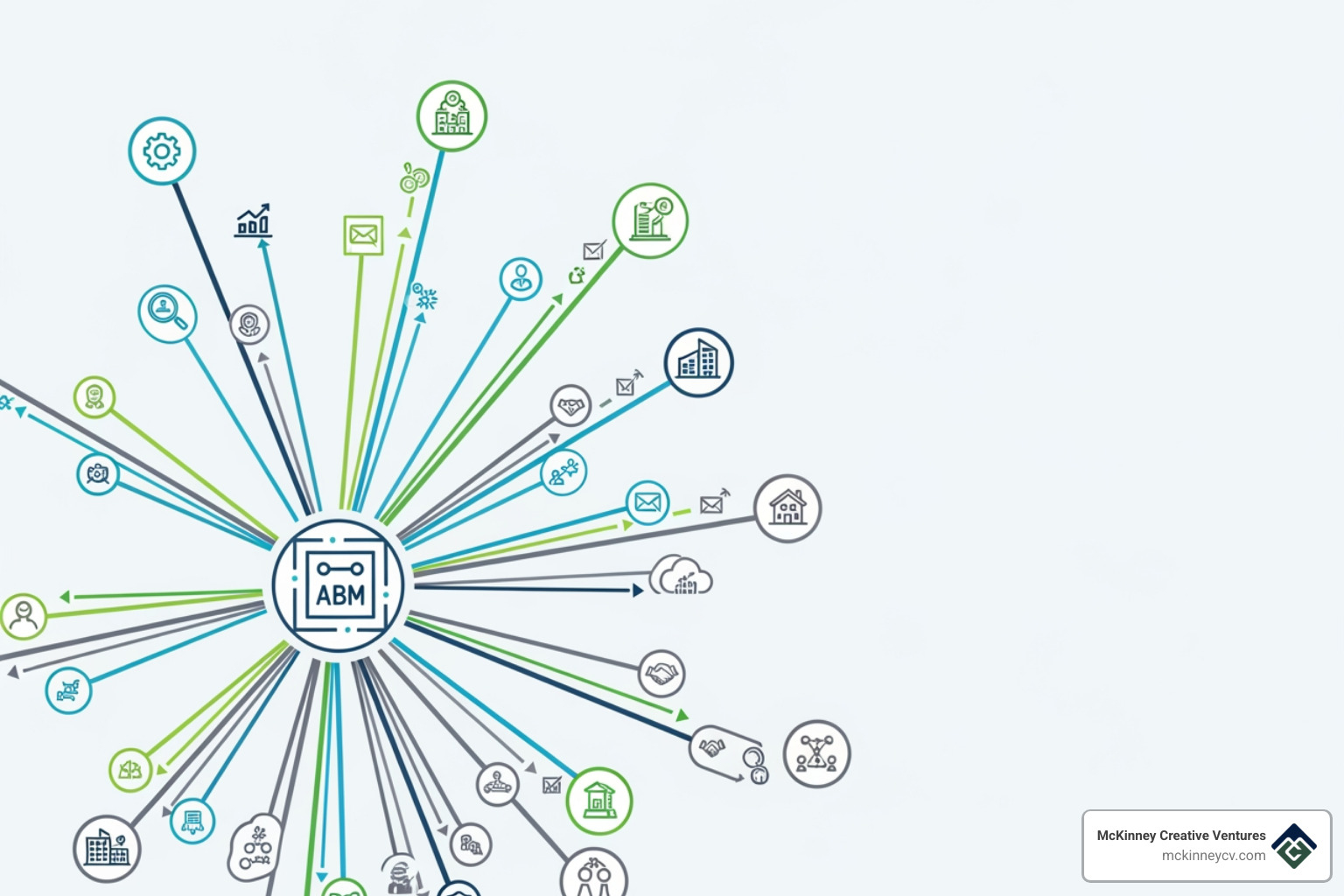
While inbound marketing draws leads to us, sometimes we need to be more proactive, especially when targeting high-value accounts in the East Metro and St. Croix Valley. This is where outbound and Account-Based Marketing (ABM) strategies come into play. These approaches involve identifying specific companies or individuals we want to work with and then reaching out to them directly with highly personalized messages. This requires careful planning, robust data, and a commitment to personalization at scale.
Data-Driven Outreach and ABM
Account-Based Marketing (ABM) is a highly effective strategy for b2b lead generation for technology companies, especially when targeting specific businesses. Instead of casting a wide net, ABM focuses our marketing and sales efforts on a select group of high-value target accounts. This allows for deeply personalized campaigns that resonate with the unique needs of each company.
A key component of data-driven outreach is using intent data. This data tells us which companies are actively researching solutions like ours, even if they haven't contacted us directly. Gartner predicts that more than 70% of B2B marketers will use third-party intent data for lead generation by the end of the year. Leveraging this data allows us to reach prospects right when their buyer journey begins, potentially before they even learn about our competitors.
With ABM, personalized outreach is paramount. We engage through multiple channels: custom emails, targeted LinkedIn messages, and even direct phone calls. Social selling on LinkedIn is particularly potent, as nearly 85% of B2B teams use LinkedIn during the buying process. We can also engage in online communities like Reddit (e.g., /r/futurology, /r/technology, /r/startups) or Facebook groups like "SaaS growth hacks" (which has 26,000 members) to connect with passionate communities and industry experts in our local market.
Leveraging Partnerships and Referrals
Expanding our reach and credibility can be significantly boosted through strategic partnerships and robust referral programs. For technology companies in the East Metro and St. Croix Valley, collaborating with complementary businesses or industry influencers can open doors to new, pre-qualified audiences.
Strategic partnerships might involve co-marketing efforts, such as co-hosting webinars that bring together expertise from both companies. This not only expands our audience but also builds authority by offering diverse perspectives. Influencer marketing is also a booming space that can cut down on the conversion timeline for B2B lead generation companies by leveraging trusted voices.
Furthermore, turning our satisfied customers into advocates is one of the most cost-effective ways to generate high-quality leads. Referral programs incentivize existing clients to recommend our services to their network. Dropbox runs an amazing referral program, for which they retain their customers as well as onboard new ones by giving extra storage space. Referred customers are often more loyal and valuable, entering the sales funnel with a higher level of trust. By building a structured referral program, we empower our best clients to become our most effective sales force.
Measuring and Optimizing for Sustainable Growth
For any b2b lead generation for technology companies strategy to be truly effective, we must continuously measure and optimize our efforts. This isn't a "set it and forget it" process; it is an ongoing cycle of tracking, analyzing, and refining. We believe in making data-informed decisions, creating a feedback loop that allows for continuous improvement and ensures our marketing dollars are working hard for our clients in the East Metro and St. Croix Valley. Without clear metrics, we cannot understand what is working, what needs adjustment, or how our lead generation contributes to the bottom line.
Key Metrics for b2b lead generation for technology companies
To truly understand the success of our lead generation efforts, we need to track specific metrics that go beyond simple lead counts. Here are some key indicators we focus on:
| Metric | Description - | Cost Per Lead (CPL) | This measures the cost-effectiveness of your campaigns. It is calculated by dividing the total campaign cost by the number of leads generated. A low CPL is good, but it must be balanced with lead quality. | | Marketing Qualified Lead (MQL) to Sales Qualified Lead (SAL) Conversion Rate | This tracks the percentage of MQLs that the sales team accepts as qualified. A low rate might indicate a misalignment between marketing and sales on lead definitions. | | Customer Acquisition Cost (CAC) | This is the total cost of sales and marketing to acquire a new customer. It provides a clear picture of the investment required to win a deal. | | Customer Lifetime Value (LTV) | This metric estimates the total revenue a business can expect from a single customer account. Comparing LTV to CAC (LTV:CAC ratio) is crucial for understanding long-term profitability. | | Pipeline Contribution | This measures the percentage of the sales pipeline that originates from marketing efforts. It directly ties marketing activities to revenue generation. |
Frequently Asked Questions about B2B Tech Lead Generation
What is the difference between lead generation and demand generation?
These terms are often used interchangeably, but they refer to distinct yet complementary processes. Demand generation is the broader strategy. It focuses on building awareness and nurturing interest across the entire buyer journey so that when prospects are ready, they already trust your brand. This involves educating the market and creating a desire for your solution.
Lead generation, on the other hand, is a specific part of the demand generation funnel. It focuses on capturing contact details from prospects who have shown interest and could become customers. This often happens through gated content, webinar sign-ups, or direct outreach campaigns. Both are vital for building a healthy pipeline; demand generation creates the pool of interested prospects, and lead generation converts that interest into actionable leads.
How long does it take to see results from B2B lead generation?
The timeline for seeing results from b2b lead generation for technology companies can vary significantly depending on the strategies employed. For instance:
SEO and content marketing are long-term plays. They build organic traffic and authority over several months, with compounding returns over time. It can take 6-12 months to see significant results.
Paid advertising (PPC) and targeted outbound outreach can generate leads more quickly, often within weeks or a few months, as they directly target active buyers.
Account-Based Marketing (ABM), while highly targeted, often involves longer sales cycles due to the complexity of enterprise deals, so results might manifest over several months to a year.
Consistency is key. Lead generation is not a one-time effort but an ongoing process. Building a sustainable lead generation engine requires patience and continuous optimization.
Should I focus on inbound or outbound lead generation?
For most b2b lead generation for technology companies, a balanced approach that combines both inbound and outbound strategies yields the best results.
Inbound marketing is excellent for building a sustainable asset over time. It attracts qualified buyers who are already looking for solutions, often at a lower cost per lead in the long run. It builds trust and positions your brand as a thought leader.
Outbound marketing is effective for targeting specific high-value accounts that might not yet be aware of your solution or are deeper in the sales funnel. It allows for a more proactive and personalized approach to engage decision-makers.
The right mix depends on your specific goals, target market, and the complexity of your technology solution. We often recommend starting with a strong inbound foundation to capture existing demand, then strategically layering outbound efforts to target key accounts and accelerate growth for our local clients.
Partner with an Expert to Build Your Lead Generation System
Building a consistent lead generation engine for your technology business requires a clear strategy, disciplined execution, and continuous optimization. It is a long-term investment in your company's growth, one that focuses on creating robust systems rather than relying on one-off tactics. These systems ensure you attract, nurture, and convert high-quality leads efficiently and sustainably.
We understand that as a growing technology business in the East Metro Twin Cities or St. Croix Valley, you may not have the time or in-house resources to dedicate to building and managing a comprehensive lead generation program. That is where a fractional marketing team like McKinney Creative Ventures can provide immense value. We offer the strategic guidance, hands-on support, and consistent follow-through needed to transform your marketing efforts.
We work directly with business owners, acting as an extension of your team to implement the strategies discussed here—from defining your ideal customer and crafting compelling content to leveraging data for optimized outreach. Our goal is to build a predictable and profitable lead generation system that drives real growth for your technology business, allowing you to focus on what you do best: innovating and serving your customers.
Let's build a marketing strategy that drives real growth for your business. We are ready to help you attract the right customers in the East Metro Twin Cities and St. Croix Valley. Let's build a marketing strategy that drives real growth for your business.