

Website Wonders & SEO Spends: Navigating Digital Marketing Costs for Small Businesses
Why Understanding Digital Marketing Cost for Small Business Matters
Digital marketing cost for small business typically ranges from $2,500 to $12,000 per month, depending on your goals, industry, and the services you choose. Here's what influences that number:
Business size and growth stage: Startups often invest 10-20% of projected revenue, while established businesses may allocate 7-10%
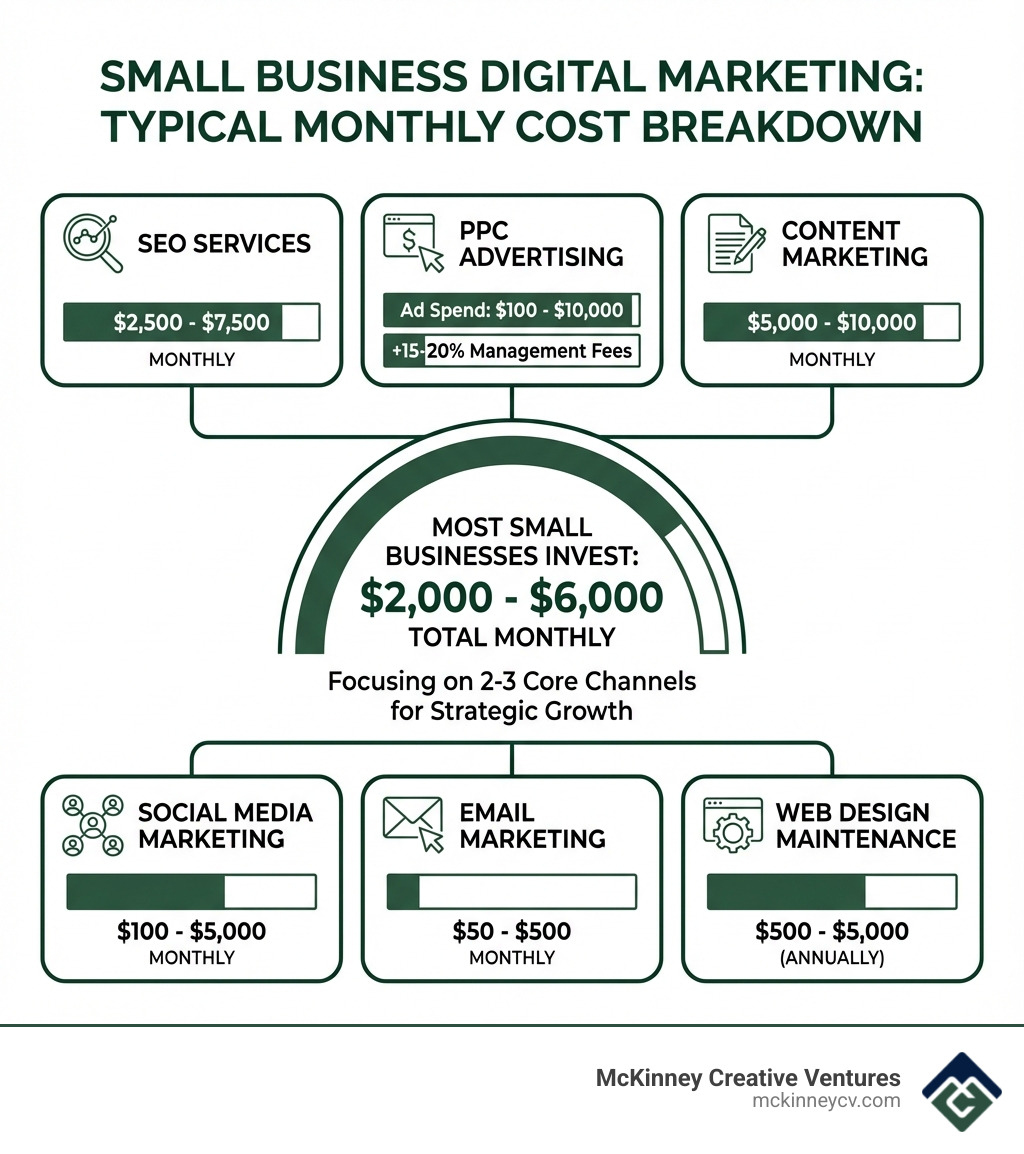
Marketing channels selected: SEO ($2,500-$7,500/month), PPC ($100-$10,000/month), content marketing ($5,000-$10,000/month), email marketing ($50-$500/month)
Industry competitiveness: More competitive markets require higher investment to gain visibility
Geographic scope: Local targeting typically costs less than national campaigns
In-house vs. outsourced: Agency retainers vs. full-time employee salaries ($50,000-$70,000 annually plus benefits)
If you're asking "How much should I spend on marketing?" you're asking the right question. But the answer isn't simple. Around 55% of small and mid-size businesses spend less than $50,000 annually on marketing, yet many struggle to see the returns they expect. The problem? They often start with a number they can afford rather than a strategy aligned with their business goals.
The digital marketing market is projected to reach $689 billion by 2028, up from less than $200 billion today. That explosive growth tells you one thing: businesses that invest strategically in digital marketing are seeing results. But "investing strategically" doesn't mean spending more. It means spending smarter.
This guide will help you understand what different marketing services actually cost, why those prices vary so much, and how to build a budget that drives real growth for your business. We'll cut through the confusion of agency proposals, break down what you're actually paying for, and show you how to measure whether your investment is working.
I'm Sam McKinney, and I've helped service-based businesses build smarter, more connected marketing systems for over 15 years. I've seen how understanding digital marketing cost for small business helps owners make confident decisions that lead to sustainable growth.
Understanding the Numbers: What's the Average Digital Marketing Cost for Small Business?
When we talk about the digital marketing cost for small business, we're often looking at a broad spectrum. The average cost for small to mid-size businesses (SMBs) typically falls between $2,500 and $12,000 per month. Some small businesses in the East Metro and St. Croix Valley might invest as little as a few hundred dollars, while others with aggressive growth goals could allocate up to $10,000 or even $20,000 monthly.
It's crucial to view this as an investment, not merely an expense. Just like any smart business investment, digital marketing aims to generate a return that far outweighs the initial outlay. The digital marketing market is booming, expected to reach an astounding $689 billion by 2028. This growth isn't just about more spending; it reflects the proven ability of digital marketing services to drive tangible results for businesses worldwide, including right here in our communities.
There's no single, fixed number for what your business "should" spend. The reality is, what works for a startup in Woodbury, MN, might be completely different from an established service business in Hudson, WI. Our goal is to help you understand the variables so you can make an informed decision that aligns with your unique business needs.
Why Averages Can Be Misleading
Averages provide a starting point, but they can also be deceptive. For instance, a brand new business in Cottage Grove, MN, trying to establish its presence will have a very different marketing strategy and budget than a ten-year-old company in Stillwater, MN, looking to maintain market share or expand into new services.
Startups vs. established businesses: New ventures often need to spend a higher percentage of their projected revenue (sometimes 10-20%) to build brand awareness and acquire initial customers. Established businesses, with existing customer bases, might spend 7-10% of their actual revenue to maintain and grow.
Aggressive growth goals: If your aim is rapid expansion, you'll likely need a more substantial investment in high-impact channels like paid advertising.
Industry competition: Highly competitive industries, like certain home services in Minneapolis, MN, often require higher bids for keywords in paid ads and more robust SEO efforts to stand out. Less competitive niches, perhaps a specialized craft business in Afton, MN, might achieve good results with a more modest investment.
Local vs. national focus: For businesses primarily serving the East Metro and St. Croix Valley, local SEO and geo-targeted ads can be incredibly effective and often more cost-efficient than broader national campaigns. Our focus is always on connecting you with customers right here in our community.
Service-based vs. e-commerce: A service-based business, like a plumber in Maplewood, MN, might prioritize local SEO and lead generation, while an e-commerce store might invest heavily in product-focused PPC and social media advertising.
The "It Depends" Answer: What Your Budget Truly Depends On
Your digital marketing cost for small business isn't about fitting into an average; it's about aligning with your specific circumstances. We believe in a "strategy first" approach. Before we even talk about costs, we need to understand:
Business goals: Are you looking for more leads, increased sales, higher brand recognition, or a combination? Your goals will dictate the channels and tactics we employ.
Target audience: Who are you trying to reach? Where do they spend their time online? Understanding your ideal customer helps us choose the most effective and efficient platforms.
Chosen channels: Different digital marketing channels have different cost structures. For example, email marketing is generally more affordable than a comprehensive SEO campaign.
Scope of work: Do you need a simple website update or a complete content marketing overhaul? The breadth and depth of services directly impact the cost.
Long-term strategy: Are we building a sustainable organic presence through SEO, or focusing on immediate traffic with PPC? A long-term vision helps us allocate resources effectively over time.
Key Factors That Shape Your Marketing Spend

Understanding the core elements that drive digital marketing cost for small business is the first step toward building a budget that works. These factors are interconnected, and a shift in one can significantly impact another.
Your Business Goals and Growth Stage
Your business goals are the compass for your marketing budget. Are you looking for maintenance or aggressive growth?
Maintenance vs. growth budget: If you're an established business with steady revenue, a "maintenance" budget might focus on keeping your current rankings and customer engagement. If you're a startup in Woodbury or a growing business in River Falls, WI, aiming for rapid expansion, a "growth" budget will be much larger and more focused on aggressive customer acquisition.
The 7-10% of revenue rule: Many industry experts suggest that small businesses allocate 7-10% of their overall revenue to marketing. For a growth-oriented business, this might push towards the higher end, even 10-14%. For new businesses without established revenue, a higher percentage of projected revenue (10-20%) is often necessary to gain initial traction.
Brand awareness objectives: If your goal is to simply increase awareness in the East Metro or St. Croix Valley, your spend might lean towards social media or content marketing.
Lead generation targets: If you need a consistent flow of leads for your service business in Lake Elmo, MN, your budget will likely prioritize SEO, PPC, and email marketing.
The In-House vs. Fractional Team Decision
One of the biggest decisions influencing your digital marketing cost for small business is whether to manage marketing in-house or outsource it.
Full-time employee costs: Hiring a full-time marketing specialist can cost $50,000-$70,000 annually, plus benefits (health insurance, retirement, paid time off, etc.). This is a significant fixed cost, and that single employee might not have expertise across all digital marketing disciplines.
Agency retainers: Digital marketing agencies typically charge monthly retainers, ranging from $2,500 to $12,000 per month for SMBs, or even higher for comprehensive strategies. This provides access to a team of specialists.
Fractional marketing benefits: This is where our model at McKinney Creative Ventures shines. As a fractional marketing team, we offer the expertise of an entire marketing department—strategists, content creators, SEO specialists—without the overhead of a full-time employee. You get consistent support and specialized knowledge at a predictable monthly cost.
Access to specialized expertise: A fractional team brings diverse skills that a single in-house hire often can't match. This means you have experts in SEO, PPC, content, and more, all working together on your strategy.
Scalability: We can scale our services up or down as your business needs evolve, offering flexibility that a full-time hire simply can't. This is especially beneficial for small businesses in areas like Woodbury, MN, or Hudson, WI, where market conditions can shift.
A Practical Breakdown of Digital Marketing Service Costs
Let's explore the specifics of what you can expect to pay for different digital marketing services. This section will help clarify typical cost ranges, what's included, and the crucial distinction between ad spend and management fees.
SEO (Search Engine Optimization): The Long-Term Foundation
SEO is about improving your website's visibility in search engine results. It's a long-term play, but the returns are often substantial and sustainable. For small businesses in the East Metro and St. Croix Valley, focusing on local SEO is particularly powerful.
Cost range: SEO services for SMBs typically cost between $2,500 and $7,500 per month. For businesses with less complex needs or a very local focus, this might start around $500-$2,000 per month.
What's included: A comprehensive SEO strategy includes:
On-page optimization: Optimizing website content, meta descriptions, and headings for relevant keywords.
Technical SEO: Ensuring your website is fast, mobile-friendly, and easily crawlable by search engines.
Content strategy: Creating high-quality, relevant content that answers your audience's questions.
Local SEO: Optimizing your online presence for local searches, including maintaining a strong Google Business Profile. This is critical for businesses in specific areas like Stillwater, MN, or River Falls, WI.
Link building: Acquiring high-quality backlinks to boost your site's authority.
Why it's an investment: SEO takes time to yield results (typically 6-12 months for significant impact), but once achieved, it drives consistent, organic traffic without additional costs per click. SEO can deliver an impressive long-term ROI of 500%-1300%.
PPC (Pay-Per-Click) Advertising: For Immediate Visibility
PPC advertising offers immediate visibility and traffic, making it ideal for launching new services, promoting seasonal offers, or competing for high-intent keywords.
Cost range: Your actual ad spend for PPC campaigns can range from $100 to $10,000 per month, or even more, depending on your industry and competition. For example, highly competitive industries often see higher cost-per-click rates.
Management fees: A crucial detail many businesses miss: the ad spend you pay to platforms like Google or Facebook is separate from agency management fees. Agencies typically charge 10-20% of your ad spend (or a flat fee) for managing your campaigns. So, if you spend $5,000 monthly on Google Ads, you'll pay that $5,000 directly to Google, plus an additional $750-$1,000 to your agency for their expertise.
Channels: This includes Google Ads (Search, Display), social media ads (Facebook, Instagram, LinkedIn), and other paid platforms.
Understanding high cost-per-click keywords: In some industries, the average cost per click can reach $3.80, with even higher rates for specific, high-value keywords. For example, a local emergency service in St. Paul, MN, might pay a premium for keywords like "emergency plumber near me" because the intent is so high. We help you steer these costs to ensure your ad spend is efficient and effective.
ROI: PPC typically delivers an ROI of around 200%, offering consistent and immediate outcomes.
Content & Email Marketing: The ROI Powerhouses
These two channels are often highly cost-effective, offering exceptional returns when done right.
Content marketing:
Cost range: Content marketing for SMBs typically costs between $5,000 and $10,000 per month. For businesses just starting, it might begin smaller, focusing on a few key pieces.
What's included: This involves creating valuable, relevant content like blog posts, articles, videos, infographics, and case studies. The cost is driven by the quality, volume, and format of the content. Visual content, like videos, is often more engaging but also more expensive to produce than text alone.
Content quality impact: High-quality content is essential not just for engaging your audience but also for supporting your SEO efforts. It helps establish your business as an authority in your field, whether you're a landscaper in Woodbury, MN, or a financial advisor in Hudson, WI.
Email marketing:
Cost range: Email marketing is generally more affordable, with services for SMBs often costing between $50 and $500 per month.
What's included: This covers email service provider fees (which scale with your list size), campaign creation, list segmentation, personalization, and automation.
Unparalleled ROI: Email marketing consistently delivers exceptional results, with an unparalleled ROI of $36 for every $1 invested. It's a direct, personal, and highly effective way to nurture leads and build customer loyalty. We often recommend it as a foundational element for our clients in the East Metro and St. Croix Valley due to its efficiency.
How to Build a Smart Marketing Budget (That Actually Works)
Building an effective marketing budget isn't about guesswork; it's about strategic planning. We approach budgeting with a "strategy first" mindset, ensuring every dollar spent works towards your business objectives.
Step 1: Define Your Business Goals (Not Marketing Goals)
Before we talk about tactics or channels, we need to clarify what success looks like for your business overall. This isn't about "getting more social media followers"; it's about tangible business outcomes.
Specific revenue targets: Do you want to increase revenue by 15% next year?
New customer goals: How many new clients do you need to acquire each month to hit your revenue targets?
Desired annual growth rate: What is your overarching growth ambition for the next 12-24 months?
Once we have clear business goals, we can reverse-engineer the marketing efforts needed to achieve them.
Step 2: Choose Your Budgeting Approach
There are a few common ways to approach your marketing budget, and we can help you find the right fit.
Percentage of revenue method: This is a popular starting point. As mentioned, 7-10% of your total revenue is a common guideline, with higher percentages for aggressive growth or new businesses. For example, if your business in Stillwater, MN, generates $500,000 in annual revenue, you might allocate $35,000-$50,000 per year to marketing.
Task-based budgeting: This method involves identifying all the marketing activities required to meet your goals (e.g., "three blog posts per month," "manage Google Ads campaign," "local SEO optimization") and then costing out each task. This approach ensures your budget directly supports your strategy.
Goal-driven budgeting: This method starts with your desired outcomes and works backward to determine the necessary investment. This is our preferred approach because it ensures your marketing spend is directly tied to achieving your business objectives.
To help you get started, we've even put together a resource: Download our Free SMB Budget Planner.
Step 3: Measure What Matters: Calculating Your Return
Spending money on marketing without measuring its impact is like driving blind. We focus on key metrics that directly tie back to your business's bottom line.
Customer Acquisition Cost (CAC): How much does it cost to acquire a new customer through your marketing efforts? This helps us understand the efficiency of different channels.
Customer Lifetime Value (CLV): How much revenue does an average customer generate over their relationship with your business? Knowing this helps justify your CAC.
Blended Lead Cost concept: Instead of looking at the cost of leads from individual channels in isolation, we consider the "blended lead cost." This acknowledges that customers often interact with your brand across multiple channels (e.g., seeing a social media ad, then searching on Google, then visiting your website) before converting. It provides a more holistic and accurate view of your overall marketing ROI.
Multi-touch attribution: This means understanding all the touchpoints a customer has with your brand before making a purchase. It helps us attribute success more accurately across your various digital marketing efforts.
Frequently Asked Questions about Small Business Marketing Costs
We often hear similar questions from business owners in the East Metro and St. Croix Valley when they're considering their marketing investment. Let's address some of the most common ones.
How much should a brand new small business spend on marketing?
For a brand new small business, especially in the East Metro and St. Croix Valley, we often recommend a higher initial percentage of projected revenue, typically 10-20%. This aggressive investment is crucial for:
Building initial market traction: Getting your name out there and acquiring your first customers.
Focus on foundational channels: Establishing a strong online presence with local SEO, a user-friendly website, and potentially some targeted local paid ads.
Testing and learning: Using a slightly larger budget allows for experimentation to find what resonates best with your local audience.
As your business grows and establishes consistent revenue, you can then adjust your marketing spend to the more typical 7-10% range.
Are ad budgets included in agency management fees?
This is a common point of confusion, and the answer is a resounding no, they are separate.
Management fee covers strategy and execution: The fee you pay to a digital marketing agency (or a fractional team like ours) covers our expertise, time, and resources to strategize, set up, manage, and optimize your campaigns. This includes keyword research, ad copy creation, audience targeting, bidding strategies, and performance reporting.
Ad spend is paid directly to the platform: The actual money spent on displaying your ads (e.g., to Google, Facebook, LinkedIn) is paid directly by you to those platforms.
Example calculation: If we're managing a Google Ads campaign for you, and we recommend a monthly ad spend of $2,000, you would pay $2,000 to Google. Our management fee, typically 15-20% of that ad spend, would be an additional $300-$400 paid to us. It's essential to understand this distinction upfront to accurately budget for your PPC campaigns.
What is a realistic digital marketing ROI for a small business?
Realistic ROI expectations vary significantly by channel and the specific goals of your campaign. Patience and a long-term perspective are key, especially for strategies like SEO.
SEO: While slower to show initial returns, SEO tends to deliver a higher long-term ROI, often ranging from 5:1 to 10:1 (meaning for every $1 invested, you get $5-$10 back in revenue). This is because organic traffic, once established, is "free" per click.
PPC: Paid advertising can provide quicker results, with a typical ROI of around 2:1 to 4:1. This means you might get $2-$4 back for every $1 spent. It's excellent for immediate lead generation or driving traffic during peak seasons in areas like Woodbury or Stillwater.
Email Marketing: This channel consistently boasts some of the highest ROIs, with many businesses seeing returns that exceed 36:1 for every dollar invested. Its low cost and high conversion potential make it a powerhouse for nurturing leads and customer retention.
Importance of patience and long-term perspective: Some strategies, like SEO and content marketing, build momentum over time. Don't expect overnight miracles. A sustained, strategic effort across multiple channels often yields the best overall returns for small businesses in our community.
Conclusion
Navigating the digital marketing cost for small business can feel complex, but with the right approach, it becomes a clear path to growth. Our main takeaway is simple: always prioritize strategy before price. Digital marketing isn't just an expense; it's a powerful, long-term investment that, when executed thoughtfully, makes money for your business.
We've explored how average costs can be misleading, the key factors that shape your marketing spend, and a practical breakdown of what different services entail. We've also emphasized the importance of defining clear business goals and measuring what truly matters to ensure a strong return on your investment.
As a fractional marketing team for small businesses in the East Metro and St. Croix Valley, McKinney Creative Ventures helps you build a plan that makes sense for your goals and budget. We focus on creating consistent, sustainable growth, acting as your dedicated marketing partner. We're here to help you make confident decisions that translate into real business results, allowing you to focus on what you do best.
Ready to build a marketing plan that drives real results? Let's talk strategy.