

From Zero to Hero: How Agents Can Master Lead Generation
Why Lead Generation for Agents Is a Systems Problem, Not a Luck Problem
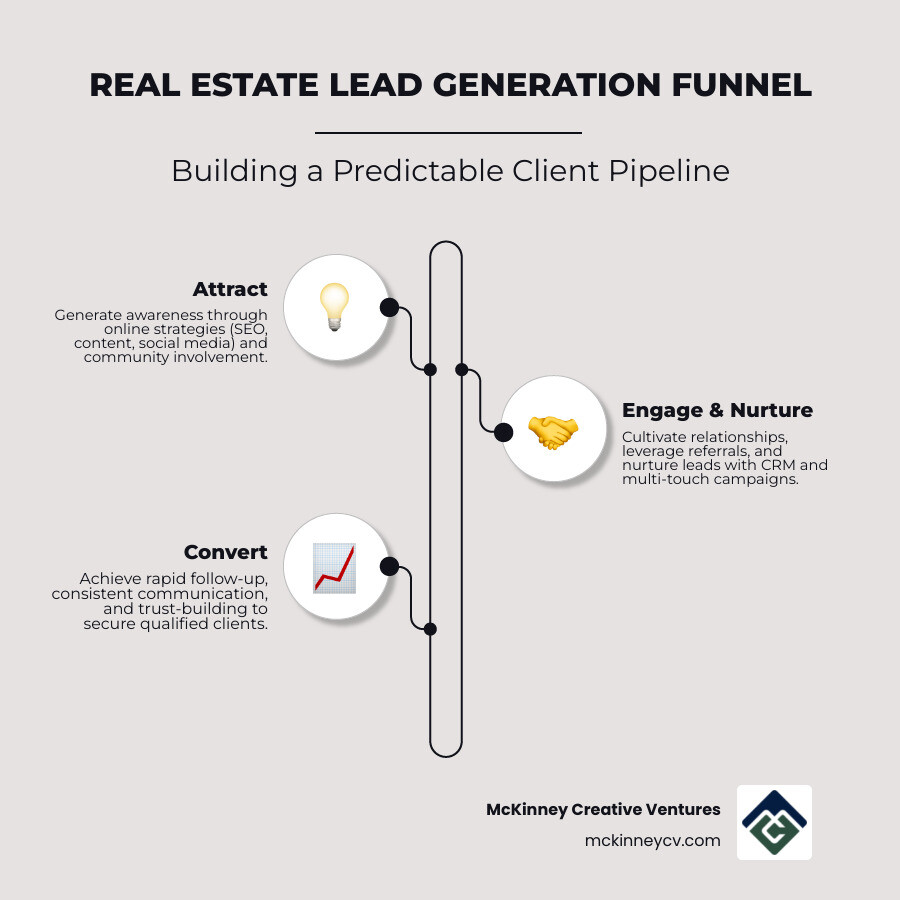
Lead generation for agents is the process of attracting and converting potential buyers and sellers into qualified clients. Success requires a strategic, multi-channel approach:
Online strategies - Website optimization, SEO, social media, content marketing, and paid advertising
Relationship building - Referrals from past clients, sphere of influence, and community networking
Lead nurturing systems - CRM tools, automated follow-up, and multi-touch campaigns
Conversion tactics - Fast response times (within 5 minutes), consistent communication, and trust-building
The world of real estate runs on leads. Without them, your calendar stays empty and your income becomes unpredictable. Yet most agents approach lead generation like a side project rather than a core business system. They chase one tactic at a time, hoping something sticks, and wonder why their pipeline feels like a rollercoaster.
The truth is simpler than most marketing gurus make it sound. Lead generation is not about finding a magic channel or spending thousands on ads. It is about building repeatable systems that work together to keep your pipeline full.
Referrals remain the highest-converting lead source for agents, but relying solely on referrals creates the feast-or-famine cycle that keeps so many agents stuck. A sustainable business requires diversification across digital and offline channels, consistent follow-up, and the discipline to track what works.
Responding to a new lead within five minutes increases your chances of converting them by 20x. Most agents spend between $0 and $250 per month on lead generation, but the real question is not how much you spend. It is whether you have a system in place to capture, nurture, and convert those leads efficiently.
I am Sam McKinney, and over the past 15 years, I have helped service-based businesses build smarter marketing systems that generate consistent growth through lead generation for agents and other local professionals. Let me walk you through the strategies and systems that turn inconsistent results into predictable revenue.
Building Your Foundation: Strategy Before Tactics
Before we dive into specific tactics, we need to lay a solid foundation. Just like building a home, you would not start framing walls without a blueprint. The same principle applies to lead generation for agents. Our approach always starts with strategy, because without it, even the best tactics can lead to wasted effort.
This means defining your ideal client. Who do you best serve in the East Metro Twin Cities or St. Croix Valley? Are they first-time homebuyers in Maplewood, growing families in Woodbury, or empty nesters looking to downsize in Hudson? Understanding your niche helps us tailor our messaging and target our efforts effectively.
Next, we craft your unique value proposition. What makes you different from other agents in our competitive local market? Perhaps it is your deep knowledge of Lake Elmo school districts, your expertise in historic homes in Stillwater, or your unparalleled negotiation skills in River Falls. This unique selling point is what attracts the right leads to you.
Building a strong online brand is non-negotiable in today's market. Your brand is your reputation, your promise to clients, and what sets you apart. The importance of a professional website cannot be overstated. It serves as your 24/7 digital storefront, showcasing your expertise and connecting with potential clients. Did you know that 97% of homebuyers use the internet in their search? This statistic highlights why your online presence is not just an option, but a necessity.
Differentiating Yourself in a Crowded Market
In our busy East Metro and St. Croix Valley real estate markets, standing out is key. Clarifying your brand identity is the first step. Are you the go-to expert for luxury properties in Afton, or the most trusted advisor for first-time buyers in Cottage Grove? Once we know who you are, we can effectively communicate it.
Niche marketing allows us to focus our efforts on a specific segment of the market, making us the undisputed expert in that area. This could be focusing on relocation buyers moving to the Greater Twin Cities Metro, or working with sellers of lakefront properties in Hudson, WI.
Showcasing your expertise builds credibility. This means sharing your market insights, your successful transactions, and your knowledge of local communities like North St. Paul or Baldwin, WI. Building trust online comes from consistent, valuable content and genuine interactions. Finally, establishing local market authority positions you as the expert people turn to for real estate advice in areas like Roseville or New Richmond, WI.
Optimizing Your Online Presence for Inbound Leads
Once your foundation is solid, we optimize your online presence to attract inbound leads. This means ensuring your website is designed with a mobile-first approach, as many prospective clients will be searching on their phones.
Local SEO basics are fundamental for agents in our specific communities. We want you to show up when someone searches for "real estate agent Maple Grove" or "homes for sale Prescott, WI." This involves using geo-modified keywords on your pages and ensuring your content speaks to the local market. User experience (UX) on your website is also crucial; it needs to be easy to steer, fast-loading, and visually appealing. Clear calls-to-action (CTAs) guide visitors to take the next step, whether it is to request a home valuation or schedule a showing.
A vital piece of your local online presence is optimizing your Google Business Profile. This free tool allows you to control how your business appears on Google Search and Maps, including your hours, contact information, and reviews. For agents in our specific service areas, a well-optimized Google Business Profile is a powerful magnet for local leads.
Mastering Online Lead Generation for Agents
With a strong foundation in place, we can now master the various online channels that drive lead generation for agents. Digital marketing offers an incredible array of tools to attract potential clients, particularly in the East Metro and St. Croix Valley.

Attract Leads with Content Marketing and SEO
Content marketing is about providing value to your audience, positioning you as a trusted resource. Our content strategy focuses on creating helpful and relevant information that addresses the questions and needs of buyers and sellers in our local communities.
Blogging for real estate allows us to share market updates for St. Paul, discuss neighborhood amenities in Shoreview, or offer tips for preparing a home for sale in Arden Hills. Creating neighborhood guides for areas like Lakeland or Grant is another excellent way to attract location-specific searches and demonstrate local expertise. These guides can cover everything from local schools and parks to popular restaurants and community events.
Video marketing with YouTube is increasingly powerful. An agent's YouTube channel can target specific demographics, such as relocation buyers moving to the Greater Twin Cities Metro, or retirees looking for homes in Pine Springs. By consistently creating engaging content, you can become a go-to resource for those researching our local areas. While this example agent is not local, you can see how one agent uses YouTube to generate leads by focusing on specific buyer demographics with engaging videos about the local area.
Leverage Social Media for Consistent Engagement
Social media is a busy hub where many potential clients spend their time. Choosing the right platforms depends on your target audience.
Facebook for agents remains a dominant force. According to a NAR survey, 89% of Realtors use Facebook for lead generation. Being active on Facebook allows us to connect with potential clients where they are already engaged. Instagram for visual branding is perfect for showcasing properties, sharing community highlights, and giving a glimpse into your personality. For agents, 59% use Instagram, making it a valuable platform. Using LinkedIn for professional networking allows you to connect with other professionals who might be sources of referrals, such as mortgage lenders or home inspectors in Minneapolis.
Building a hyperlocal community group on Facebook can be a fantastic way to establish yourself as a local expert. For instance, a group focused on "Woodbury Homeowners" or "Stillwater Community Buzz" can create a space for residents to connect, ask questions, and for you to subtly offer value and expertise without being overtly salesy.
Accelerate Growth with Paid Advertising
While organic strategies build long-term authority, paid advertising can accelerate your lead generation for agents efforts, delivering immediate results.
Google Ads for high-intent searchers allows us to capture people actively looking for real estate services. Imagine someone in Cottage Grove searching "sell my house fast" or "realtor near me in Oakdale." We can target these specific searches, ensuring your ad appears at the top.
Facebook Ads for targeted demographics enable us to reach potential buyers and sellers based on their interests, behaviors, and demographics within specific geographic areas like Inver Grove Heights or South St. Paul. We can target homeowners, people interested in real estate, or even those who have recently moved. Retargeting campaigns are also incredibly effective. These ads show up for people who have already visited your website or interacted with your social media, keeping you top of mind as they continue their home search journey.
Budgeting for paid ads requires a strategic approach. It is recommended to allocate 50% of your budget to top-of-funnel leads, 30% to middle-of-funnel leads, and 20% to bottom-of-funnel leads. Creating effective lead magnets, such as a "First-Time Homebuyer's Guide to the East Metro" or a "St. Croix Valley Seller's Checklist," provides valuable content in exchange for contact information, fueling your lead nurturing efforts.
The Power of Relationships: Offline and Referral Strategies
While digital tools are powerful, the human element remains paramount in real estate. Building trust offline and cultivating strong relationships are high-conversion strategies that complement our digital efforts, especially in tight-knit communities like those in the East Metro and St. Croix Valley.
Cultivate Your Sphere of Influence (SOI) and Referrals
Your Sphere of Influence (SOI) is your most valuable asset. These are the people who already know, like, and trust you: past clients, friends, family, and professional acquaintances. Nurturing past clients is crucial, as they are your best source of repeat business and referrals. referrals are the highest-converting lead source for agents. Sixty-three percent of sellers find their agent via a referral, and 38% of buyers choose an agent based on a personal recommendation.
Building a professional referral network involves connecting with complementary businesses like mortgage brokers, home inspectors, contractors, and local businesses in areas like Hudson, WI, or Stillwater. These reciprocal relationships can be a consistent source of qualified leads. Client appreciation programs, like annual events or thoughtful gifts, keep you top of mind and reinforce those valuable relationships.
Generate Leads Through Community Involvement
Getting involved in your local community is another excellent way to generate leads. Hosting workshops and seminars on topics like "First-Time Homebuying in Maplewood" or "Selling Your Home in Woodbury's Current Market" positions you as an expert and allows for face-to-face interaction with potential clients.
Effective open house strategies go beyond just opening the door. Promote them extensively, make them memorable with small touches, and use digital sign-in sheets to capture contact information efficiently. Sponsoring local events, whether it is a school fundraiser in Lake Elmo or a community festival in Cottage Grove, improves your visibility and demonstrates your commitment to the area. Networking in your community, whether at Chamber of Commerce meetings in St. Paul or local business mixers in River Falls, allows you to build genuine connections that can lead to referrals.
Systematizing Success: Lead Nurturing and Conversion
Generating leads is only half the battle; the real victory lies in nurturing them and converting them into clients. This requires a systematic approach, ensuring no lead falls through the cracks. For lead generation for agents, this means having robust lead management systems and leveraging automation for efficiency.
The Critical Role of a CRM in Your Business
What is a CRM? A Customer Relationship Management (CRM) system is a tool that helps you manage all your interactions with current and potential clients. It is the central hub for all your lead generation for agents activities.
Centralizing lead data in a CRM means all contact information, communication history, and lead status are in one place. This allows you to track every interaction, from an initial website inquiry to a closed deal. Automating follow-up tasks is a game-changer. Your CRM can send automated email sequences, set reminders for phone calls, and even trigger text messages, ensuring consistent communication without manual effort. Tracking communication helps you personalize future interactions, knowing exactly what has been discussed and what their preferences are.
Choosing a CRM that fits your workflow is essential. It should integrate with your other tools and be intuitive to use. A good CRM can be the backbone of your entire lead generation and conversion strategy.
Mastering Follow-Up and Conversion: A Practical Guide to Lead Generation for Agents
Speed to lead is paramount. Research shows that responding to a new lead within five minutes increases your chances of converting them by 20x. In a competitive market like ours, being the first to connect often makes all the difference.
Multi-touch campaigns are highly effective because most leads require multiple touchpoints before conversion. This involves a mix of emails, calls, texts, and even social media interactions over several days or weeks. Nurturing leads through the funnel, from Middle of Funnel (MOFU) to Bottom of Funnel (BOFU), means providing different types of value at each stage. In MOFU, you are building trust and educating; in BOFU, you are addressing specific needs and driving them towards a decision.
Converting leads into clients requires persistence, value, and clear communication. You need to prove your value, showcase your experience, and gently guide them to the next step. Our research shows that a 7-day lead conversion plan can be highly effective, outlining specific actions for each day to maximize your chances of success.
Evaluating Paid Lead Approaches
Paid lead sources can be a powerful component of your lead generation for agents strategy, offering a way to scale quickly and inject new prospects into your pipeline. However, it is crucial to approach them strategically, understanding their nuances and evaluating their fit for your business in the East Metro or St. Croix Valley.
What to Know About Paid Lead Models
There are various paid lead models available to agents. These often involve paying a fee for access to potential clients who have expressed interest in buying or selling. Common models include:
Pay-per-lead services: You pay a set amount for each lead delivered.
Referral fee services (pay-at-closing): You only pay a percentage of your commission if the lead results in a closed transaction. Companies like Clever, Zillow Flex, and HomeLight operate on this model.
Advertising platforms: You pay for ad space on platforms like Google or Facebook, generating your own leads.
The typical costs and fee structures vary widely. Pay-per-lead can range from $15 to $60 per lead, while pay-at-closing referral fees can be anywhere from 15% to 40% of your commission.
When do paid leads make sense for an agent? They can be particularly beneficial for newer agents looking to build their pipeline quickly, or experienced agents aiming to scale their business beyond their existing network. They offer a predictable influx of potential clients.
However, it is vital to evaluate if a paid lead source aligns with your brand and goals. Not all leads are created equal. Some services provide highly qualified leads, while others may offer a higher volume of less engaged prospects. Understanding the quality, exclusivity, and nature of the leads is key to making a sound investment.
Pros and Cons of Paid Lead Sources
Paid lead sources offer distinct advantages, but also come with potential drawbacks that we need to consider.
Benefits of Paid Leads Drawbacks of Paid Leads Speed and Scale: Quickly expand your pipeline, especially for new agents. Higher Costs: Percentage-based referral fees can be substantial (e.g., 15-40% of commission). Targeted Leads: Some services pre-qualify leads or target specific demographics. Inconsistent Quality: Leads may not always be highly motivated or ready to transact. Risk Mitigation (Pay-at-Closing): Only pay if a transaction closes, reducing upfront financial risk. Less Control: You have less control over the lead generation process and initial client experience. Reduced Marketing Effort: Less time spent on organic lead generation activities. Competition: Leads may be shared with other agents, increasing competition for conversion. Access to New Markets: Reach buyers/sellers you might not otherwise connect with. Dependency: Over-reliance can make your business vulnerable if the source changes or becomes too expensive. Data and Analytics: Some platforms provide valuable insights into lead behavior. Not Exclusive: Many paid leads are not exclusive, meaning multiple agents may contact the same prospect.
Learn more about evaluating paid lead options and how to determine if they are the right fit for your business in our local market.
Frequently Asked Questions about Lead Generation for Agents
We often hear similar questions from agents in the East Metro and St. Croix Valley as they steer the complexities of lead generation. Here are some of the most common ones we address:
How much should a real estate agent spend on lead generation?
Most real estate agents spend between $0 and $250 per month on lead generation. However, a strategic approach involves allocating your budget across the entire sales funnel. A common guideline we recommend is to dedicate 50% of your budget to top-of-funnel awareness (attracting new prospects), 30% for middle-of-funnel nurturing (engaging interested leads), and 20% for bottom-of-funnel conversion efforts (closing deals). This balanced approach ensures a consistent flow of new leads while also maximizing your chances of converting existing ones.
What are the highest-converting lead sources for agents?
Referrals from your sphere of influence, including past clients, friends, family, and professional partners, consistently provide the highest conversion rates. These leads come with built-in trust and a warm introduction, which is a significant advantage. This is why cultivating these relationships through client appreciation and consistent communication is so vital.
How do I measure the success of my lead generation?
To truly understand the success of your lead generation for agents efforts, we recommend tracking key metrics and KPIs (Key Performance Indicators). These include:
Cost Per Lead (CPL): How much does it cost you to acquire a single lead from each channel?
Lead-to-Client Conversion Rate: What percentage of your leads actually become paying clients?
Return on Investment (ROI): For every dollar you spend on a lead generation channel, how much revenue does it bring back?
Using your CRM and tools like Google Analytics 4 (GA4) is crucial to attribute closed deals back to their original source. This allows us to see what is truly working and where to optimize our efforts for agents in our local communities.
Conclusion
Building a predictable pipeline for lead generation for agents is not about luck; it is about building effective systems. We have seen how a strategic approach, combining online and offline tactics with diligent nurturing and conversion, can transform an agent's business. Focusing on systems over one-off tactics leads to long-term, sustainable growth.
As a fractional marketing team for businesses in the East Metro and St. Croix Valley, McKinney Creative Ventures helps build the strategies and systems you need for consistent growth. We understand the local market and the unique challenges agents face. We are here to partner with you, providing the expertise and consistent support to turn your lead generation efforts into predictable revenue.