

The 7 Best Web Management Services Compared
Why Your Website Needs More Than Just Hosting
Web management services keep your website running smoothly and performing well after it's built. They include regular updates, performance monitoring, content changes, backups, and technical support so your site stays fast, functional, and available 24/7.
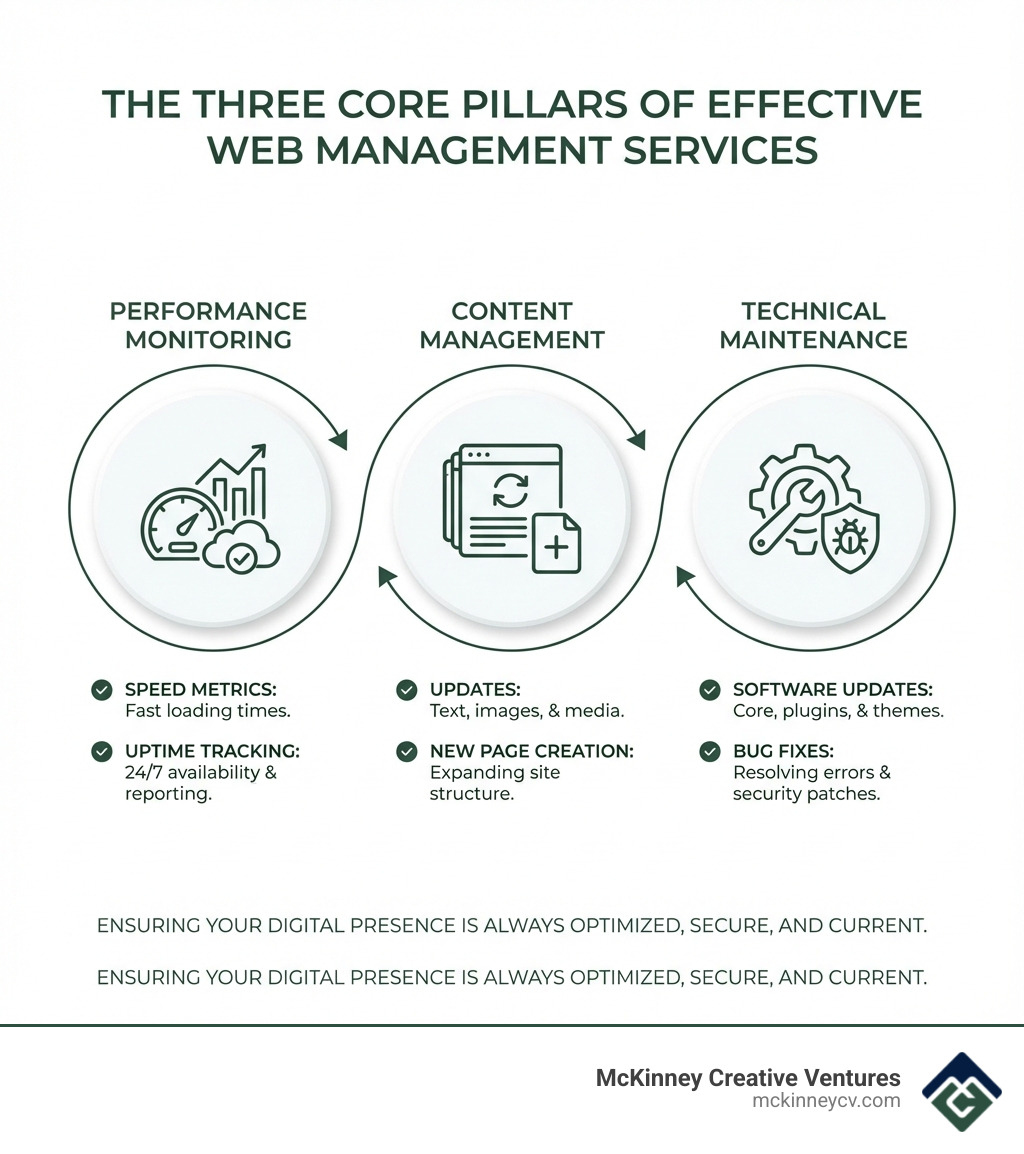
These core services cover everything from technical maintenance like software updates and bug fixes to performance optimization for speed and mobile responsiveness. They also include content updates, uptime monitoring, and reliable support for any fixes or changes you need.
Your website is often the first place potential customers find you. In fact, 88% of buyers research companies online before purchasing. If your site is slow, outdated, or broken when they visit, you've already lost the sale.
Most business owners don't realize that maintaining a website takes an average of 17 hours per month. That's time you could spend serving customers, managing your team, or growing your business. And hiring someone full-time costs $30,000 to $40,000 annually before benefits and training.
Professional web management gives you access to specialized expertise without the overhead. You get faster turnaround times, consistent upkeep, and the peace of mind that comes from knowing your digital front door is always in good shape.
I'm Sam McKinney, founder of McKinney Creative Ventures, where I've spent over 15 years helping small businesses build smarter marketing systems that include reliable web management services. I've seen how the right approach to website care transforms a business owner's ability to focus on what matters most.
What Ongoing Website Management Really Involves
Think of your website like a physical storefront. Once it's built and open for business, you wouldn't just lock the doors and walk away. You'd keep the lights on, clean the windows, rearrange displays, and make sure everything is running smoothly. Your digital storefront, your website, needs the same kind of continuous care.
Ongoing web management services go far beyond the initial build. They encompass the daily, weekly, and monthly tasks that ensure your website not only stays online but actively supports your business goals. It's about proactive care, not just reactive fixes.
Here's what that looks like in practice:
Core Services: At its heart, web management covers the essential functions that keep your site operational. This includes everything from ensuring your hosting environment is stable to making sure your domain name is renewed on time.
Technical Upkeep: Websites are built on dynamic software platforms, like WordPress, which constantly evolve. Technical upkeep involves making sure these core systems are up-to-date to ensure peak performance. This prevents compatibility issues with new browser technology and ensures your site can leverage the latest features and functionalities.
CMS Updates: If your website uses a Content Management System (CMS) like WordPress, regular updates to the CMS itself are crucial. These updates are essential for performance, bringing new features and improved compatibility with other tools.
Plugin Updates for Features: Most websites rely on plugins to add specific functionalities, whether it's an e-commerce cart, a contact form, or a photo gallery. These plugins also receive frequent updates. Keeping them current ensures they continue to function as intended and remain compatible with your core CMS. Failing to update them can lead to broken features, slow performance, or even a non-functional website.
Performance Tuning: A fast website isn't just a luxury; it's a necessity. Performance tuning involves optimizing various aspects of your site to ensure it loads quickly for your visitors. This includes optimizing images, streamlining code, and implementing caching strategies.
Content Refreshes: Your website's content isn't static. Whether it's updating service descriptions, adding new blog posts, or swapping out seasonal promotions, regular content refreshes are vital to keep your audience engaged and your information current.
Uptime Monitoring: What good is a website if it's down? Professional web management includes continuous uptime monitoring. This means tools are constantly checking if your site is accessible to visitors. If it goes down, the management team is alerted immediately, often before you even notice, allowing for swift action to get it back online. This proactive approach minimizes disruption to your business. You can learn more about the importance of tools like Website Monitoring for maintaining an always-available online presence.
Analytics and Reporting: Understanding how your website performs is key to making informed business decisions. Web management includes tracking crucial metrics through analytics tools and providing regular reports. This helps us understand visitor behavior, identify popular content, and see how your website contributes to your overall marketing goals.

This comprehensive approach ensures your website is a reliable, high-performing asset that consistently supports your business in the East Metro and St. Croix Valley. It's about keeping your digital doors open and inviting.
Why Invest in Professional Website Management?
For many small business owners, the idea of paying someone else to manage their website feels like an added expense. But when you look closely, the numbers tell a different story. Investing in professional web management services isn't just about convenience; it's a strategic move that saves you time, money, and a lot of headaches.
Let's break down the real costs and benefits:
Opportunity Cost: We know from our research that maintaining a website takes an average of 17 hours per month. For a business owner, those 17 hours are incredibly valuable. What could you accomplish if you weren't troubleshooting a broken plugin or trying to figure out why your site is loading slowly? Those hours could be spent developing new products, nurturing client relationships, or strategizing your next big move. Every minute you spend on website upkeep is a minute you're not spending on core business activities.
Time Savings: This is perhaps the most immediate and tangible benefit. By outsourcing your web management, you reclaim those 17 precious hours each month. Imagine having an extra two full workdays back! This isn't just about saving time; it's about reallocating your most valuable resource to tasks that directly generate revenue or improve your business.
In-House Hiring Costs: Some businesses consider hiring an in-house web specialist. While this might seem appealing, the costs quickly add up. The average cost to hire a qualified web professional is $30,000 to $40,000 annually before benefits, training, and overhead. For many small businesses, that's a significant investment, and you might not even have enough work to keep them fully used. A professional web management company provides a team of experts for a fraction of that cost, offering a predictable monthly budget instead of a hefty salary commitment.
Access to Specialized Expertise: When you partner with a professional web management team, you're not just getting one person's skills. You're gaining access to a collective pool of specialists who are constantly staying abreast of the latest web technologies, performance optimization techniques, and platform updates. This level of diverse, up-to-date expertise would be incredibly expensive and challenging to replicate with an in-house hire.
Faster Project Turnaround: Professional teams have established workflows and specialized tools that allow them to complete projects in a fraction of the time it might take an internal team. This means your website updates, new page additions, or performance improvements happen quickly, keeping your online presence agile and responsive to your business needs.
Freeing Up Your Team to Focus on Core Business: Professional web management allows you and your team to focus on what you do best. You didn't start your business in Woodbury, Cottage Grove, or Hudson to become a web developer. By entrusting your website's care to experts, you can dedicate your energy to serving your customers, innovating your offerings, and driving your business forward. It's about working smarter, not harder.
The peace of mind that comes with knowing your website is professionally managed is invaluable. It transforms your website from a potential source of frustration into a reliable asset that consistently performs for your business.
The 7 Key Areas to Evaluate in Web Management Services
Choosing the right partner for your web management services is a crucial decision, as impactful as selecting your accounting or legal firm. Not all web management is the same, and understanding what to look for will help you make an informed choice that truly benefits your business in the East Metro and St. Croix Valley.

Here are the seven most important areas we evaluate when helping our clients select a web management partner:
Scope of Core Technical Services
This foundational area covers the nuts and bolts of keeping your website running smoothly and effectively.
Technical Fixes: Websites, like any complex software, can encounter glitches. A good web management service will proactively identify and resolve technical issues, from broken links to display errors, ensuring a seamless user experience.
Bug Resolution: When unexpected errors or bugs appear, quick resolution is key to maintaining your site's functionality and reputation. We look for partners who have clear processes for diagnosing and fixing these issues efficiently.
Functionality Checks: Regular checks ensure all interactive elements of your website, like contact forms, navigation menus, and search functions, are working correctly. This prevents user frustration and lost opportunities.
Website Backups for Recovery: Technical issues like a failed update or server glitch can happen, and data can be lost. Robust web management includes automated, regular backups of your entire website. This means if something goes wrong, your site can be restored to a previous, functional state, minimizing downtime and data loss.
Update Process for CMS and Plugins: As mentioned earlier, CMS platforms (like WordPress) and their plugins receive frequent updates. A reliable service handles these updates methodically, testing them in a staging environment first to prevent conflicts or breakage on your live site. This keeps your site compatible with the latest web standards and operating efficiently.
Performance and Speed Optimization
In today's digital world, speed isn't just a preference; it's a critical component of user experience and search engine visibility.
Site Speed’s Impact on Search Rankings and User Experience: A slow website frustrates visitors and can cause them to leave before your content even loads. This negatively impacts your bounce rate and, consequently, your search engine rankings. Research highlights just how critical performance has become, as seen in Scientific research on site speed and conversions.
Core Web Vitals: Google uses specific metrics called Core Web Vitals to measure user experience, including loading performance, interactivity, and visual stability. Optimizing for these vitals is essential for staying competitive in search results.
Caching Strategies: Caching involves storing parts of your website so they load faster on subsequent visits. A good web management service implements effective caching strategies to significantly reduce load times.
Image Optimization: Large, unoptimized images are a common culprit for slow websites. This involves compressing images without losing quality, ensuring they load quickly across all devices.
1-Second Loading Speed Difference Stat: Even a 1-second difference in loading speed can dramatically affect user engagement and conversion rates. Our research shows that a 1-second difference in loading speed affects both your paid advertising performance and Google search rankings. This makes speed optimization a top priority for any business aiming for online success.
Content and Marketing Support
Your website is a dynamic marketing tool, and its content needs to be managed to reflect your current business offerings and marketing strategies.
Content Updates: Whether it’s changing a phone number, updating business hours, or adding a new testimonial, content updates need to be handled promptly and accurately.
Adding New Pages: As your business grows or new services are introduced, you'll need new pages on your website. A web management partner can help create and publish these pages, ensuring they are well-formatted and integrated into your site's structure.
Blog Formatting: For businesses that regularly publish blog content, proper formatting is key for readability and search engine optimization. This includes optimizing headings, images, and internal links.
Lead Generation Integration: Your website should be a lead-generating machine. This involves ensuring your contact forms, calls-to-action, and landing pages are functioning correctly and integrated with your marketing systems.
SEO Alignment: While we focus on broader marketing strategy, good web management ensures that website changes and additions align with your overall SEO strategy, helping your site rank for relevant keywords in the East Metro and St. Croix Valley.
Connecting Website Health to Marketing Goals: All web management tasks should contribute to your business objectives. A good partner understands how website performance and content directly impact your digital marketing efforts and lead generation.
Support and Communication
Effective communication and reliable support are the cornerstones of any successful partnership.
Service Level Agreements (SLAs): A clear SLA outlines the guaranteed level of service you can expect, including response times and resolution targets. This provides transparency and accountability.
Response Times: For urgent issues that impact your website's availability or critical functions, you need rapid response. Most professional web management companies guarantee response times within 1-4 hours for urgent issues. For routine requests, you should expect a response within 24 hours.
Dedicated Point of Contact: Having a consistent person or small team to communicate with ensures they understand your business, your website's history, and your specific needs. This avoids the frustration of explaining your situation to a different person every time you call.
Proactive Communication: Beyond just responding to issues, a strong partner proactively communicates about upcoming updates, potential improvements, or performance trends, keeping you informed about your website's health.
Pricing Models and Value
Understanding how web management services are priced helps you find a solution that fits your budget and provides clear value.
Subscription Tiers: This is the most common model, offering different levels of service at varying monthly prices. Basic packages typically start around $99-$299 per month, covering essential maintenance. Mid-tier services range from $300-$600 monthly, offering more comprehensive support, while enterprise packages can exceed $8,000 monthly for highly complex sites.
Flat-Fee Retainers: Similar to subscription tiers, a flat fee provides a predictable monthly cost for a defined set of services.
Pay-as-you-go Credits: Some services offer a credit system, where you purchase credits (e.g., 1 credit = 15 minutes of work) and use them as needed for updates or fixes. This can be flexible for businesses with infrequent needs.
Calculating ROI: To truly understand the value, look beyond the monthly fee. Consider the time you save, the potential for a measurable increase in website-generated leads, and the productivity gains your team will experience. Your website is an investment, and good management improves its return.
Onboarding and Workflow
A smooth start sets the stage for a successful long-term partnership.
Typical Onboarding Process: This usually begins with a "findy phase" where the management team learns about your business, your website's history, and your specific goals.
Goal Setting: During onboarding, you'll work with your new partner to define clear objectives for your website and how management services will support them.
Access and Credentials Transfer: Securely transferring necessary access and credentials (like hosting logins, CMS access) is a critical step.
Communication Channels: Establishing preferred communication methods and points of contact ensures everyone is on the same page.
2-4 Week Onboarding Timeline: The onboarding process for a new web management client typically spans 2-4 weeks, allowing enough time to gather all necessary information and set up monitoring and reporting systems effectively.
Reporting and Key Performance Indicators (KPIs)
You can't manage what you don't measure. Transparent reporting is essential for demonstrating the value of web management services.
Measuring Success: How do you know your investment is paying off? A good partner will provide clear metrics.
Monthly Reports: These reports should summarize all activities performed, highlight key website performance metrics, and offer insights into how your site is contributing to your business goals.
Key Metrics to Track: Look for reporting on: - Uptime Percentage: Demonstrating that your website is consistently available to visitors. - Page Load Speed: Showing improvements in how quickly your site loads. - Conversion Rate Improvements: Tracking how effectively your website turns visitors into leads or customers. - Organic Traffic Growth: Indicating improvements in your site's visibility in search engine results.
These KPIs provide a clear picture of your website's health and its contribution to your overall digital marketing strategy.
Frequently Asked Questions about Website Management
Let’s answer a few of the most common questions business owners in the East Metro and St. Croix Valley have when considering a website management partner.
How much should I expect to pay for web management?
The cost of web management services varies widely based on the complexity of your website, the scope of services included, and the level of support you need.
Pricing Models Explained: As we discussed, you'll typically find subscription tiers, flat-fee retainers, or pay-as-you-go credit systems.
Basic Packages: For smaller websites with infrequent update needs, basic packages usually start around $99-$299 per month. These might cover core CMS updates, backups, and basic uptime monitoring.
Mid-Tier Services: If you have a more active website, perhaps an e-commerce store or a blog you update regularly, mid-tier services ranging from $300-$600 monthly would be more appropriate. These often include more comprehensive content support, performance optimization, and faster response times.
Enterprise-Level Costs: For large, complex websites with high traffic, extensive functionalities, or specific integration needs, enterprise packages can exceed $8,000 monthly.
Finding Value Over the Lowest Price: The cheapest option isn't always the best. Consider the value you receive in terms of time saved, expertise gained, and the positive impact on your business's online performance and lead generation.
How quickly can I expect changes to be made?
Response time is a critical component of professional web management services.
Response Time Guarantees: Reputable companies will have Service Level Agreements (SLAs) that outline specific response times.
Routine vs. Urgent Requests: For routine requests, such as minor content updates or bug fixes, you should expect a response within 24 hours. For urgent issues that severely impact your website's functionality or availability, response times are typically much faster, often within 1-4 hours.
Same-Day Edits for Simple Tasks: Many simple content changes, like updating text or swapping an image, can often be completed the same day they are requested, especially if they fall within routine business hours.
Setting Clear Expectations: During your onboarding, your web management partner should clearly define what constitutes an "urgent" versus a "routine" request and what their guaranteed turnaround times are for each.
What’s the difference between web management and web hosting?
These two terms are often confused, but they represent distinct and equally important aspects of your online presence.
Hosting as the “Land”: Think of web hosting as the plot of land where your business resides online. It's the physical space on a server that stores all your website's files, databases, and content, making them accessible to anyone on the internet. Without hosting, your website simply wouldn't exist online.
Website as the “House”: Your website itself is the "house" built on that land. It's the structure, the design, the rooms (pages), and all the furnishings (content, images, interactive elements) that make it functional and appealing to visitors.
Management as the “Maintenance Crew”: Web management services are like the dedicated maintenance crew for your house. They ensure the foundation (CMS) is stable, the plumbing (plugins) works, the paint (content) is fresh, and everything is running efficiently. They don't own the land (hosting) or build the house (website design), but they keep it in top shape, perform regular upkeep, and fix issues as they arise.
In short, hosting provides the space, your website is the structure, and web management keeps everything working perfectly so your digital storefront in Minneapolis, St. Paul, or River Falls is always ready for business.
Conclusion
Your website is your most valuable digital asset, and it needs ongoing care to perform its best. Choosing the right management partner is a strategic investment that provides peace of mind and lets you focus on what you do best: running your business. For small businesses in the East Metro and St. Croix Valley, McKinney Creative Ventures acts as that trusted, local fractional marketing team. We ensure your website is always working for you, performing optimally, and supporting your growth.
Ready to learn how a fractional marketing team can simplify your online presence and drive real results?