

Small Business Website Maintenance: Unpacking the Price Tag
Your Website Is Your Digital Storefront. Is It Well-Maintained?
Website maintenance cost for small business typically ranges from $35 to $500 per month, depending on your site's size, complexity, and the level of support you need. Here's a quick breakdown:
Website Type Typical Monthly Cost Basic informational site $35 - $100 Small e-commerce site $75 - $300 Custom or complex site $200 - $1,000+
Additional annual costs include domain renewal ($10-$60), SSL certificates ($0-$300), and hosting ($2-$500/month).
Your website is often the first impression a potential customer has of your business. It's your digital storefront, open around the clock. But just like a physical storefront, it needs regular care to stay welcoming, functional, and effective.
Neglecting website maintenance can lead to real problems. Slow load times, broken links, outdated information, and compatibility issues all hurt the user experience. They can also damage your search engine rankings and your brand reputation.
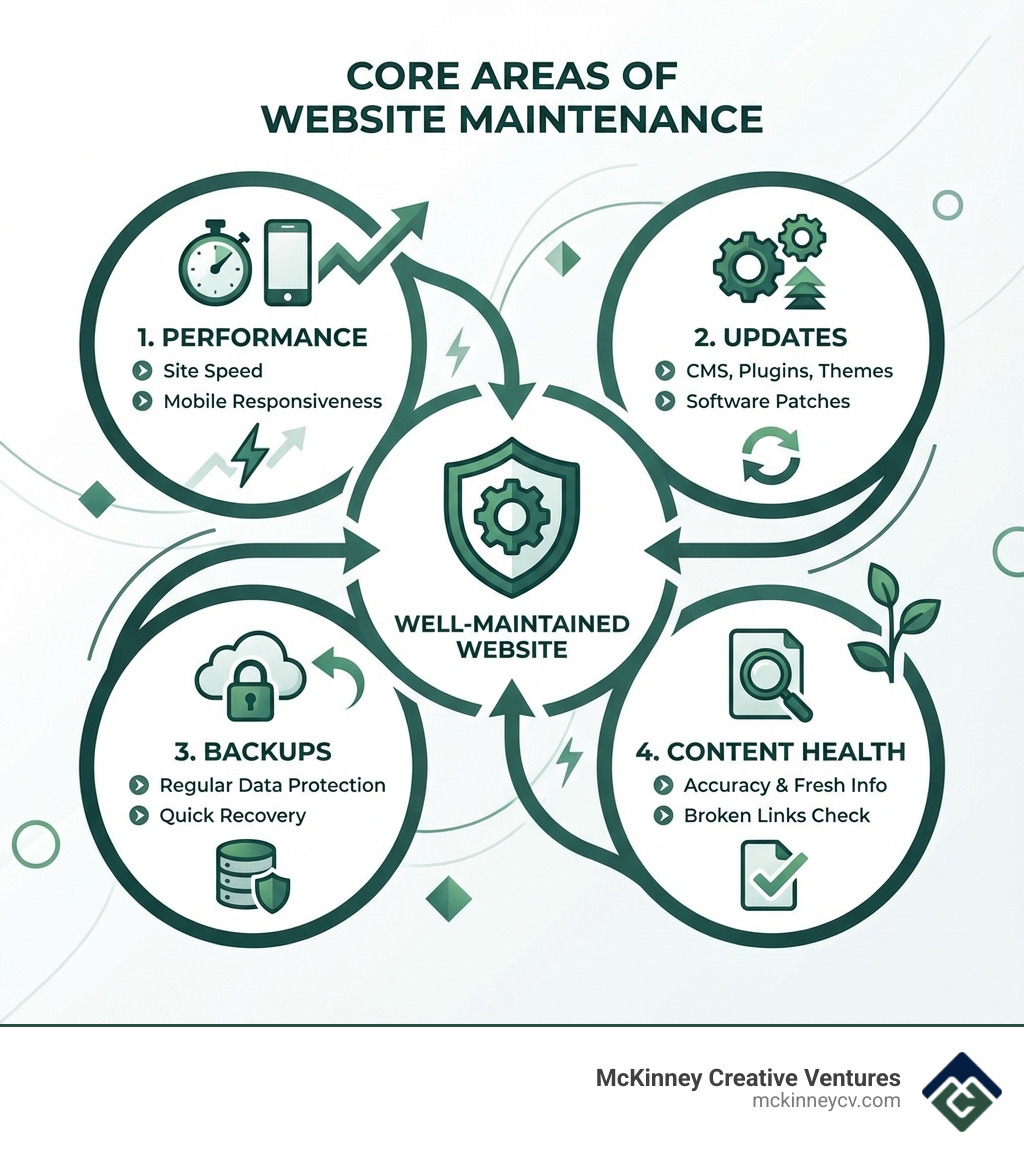
Regular maintenance is not just about fixing what's broken. It's about keeping your site running smoothly, protecting your investment, and ensuring your online presence supports your business goals. It includes software updates, performance checks, content refreshes, and routine backups.
Understanding what goes into website maintenance and what it costs helps you budget appropriately and make informed decisions about how to manage this essential part of your business.
I'm Sam McKinney, founder of McKinney Creative Ventures, and I've spent over 15 years helping small businesses build and maintain effective digital marketing systems, including managing website maintenance cost for small business in a way that delivers real value. In this guide, we'll break down the components of website maintenance, typical costs, and how to choose the right approach for your business.
Why Regular Maintenance Is a Smart Business Investment
In today's digital world, your website is more than just an online brochure; it is a critical asset for your business. Think of it like your company vehicle or your physical office space. You wouldn't let your business vehicle go without an oil change, or your office fall into disrepair, would you? The same principle applies to your website. Regular website maintenance is a proactive investment that safeguards your initial build, improves user experience, and drives your marketing efforts forward.
We understand that every dollar counts for small businesses in the East Metro Twin Cities and St. Croix Valley. That is why we emphasize that consistent website care isn't an expense; it is a smart investment that prevents larger, more costly issues down the road. Skipping regular check-ups might save a few dollars in the short term, but it often leads to significant problems later, such as broken pages, outdated information, or a decline in your search engine visibility.
Visitors expect a seamless experience when they land on your site. They want pages to load quickly, information to be current, and navigation to be intuitive. Studies show that roughly half of all web traffic today comes from mobile devices, so if your site is not optimized for mobile, it can leave users struggling and likely abandoning your site quickly. A well-maintained website ensures that your visitors have a positive interaction, forming a strong impression of your brand in a matter of seconds.
Beyond user experience, regular maintenance plays a crucial role in your site's performance in search engines. Platforms like Google prefer websites that are regularly updated with fresh, relevant content and that load quickly. By keeping your site in top shape, you are actively supporting your search engine optimization (SEO) efforts, which means more potential customers can find you.
Consistent website maintenance supports your overall marketing and business development. It keeps your digital storefront welcoming, efficient, and ready to convert visitors into customers, ensuring your online presence continues to work hard for your business.
The Primary Cost Components of Website Maintenance
Understanding where your money goes when it comes to website maintenance is the first step toward effective budgeting. It is not a single, vague cost but rather a collection of essential components that keep your site running smoothly. Each of these elements contributes to the overall website maintenance cost for small business.

Let's break down the primary cost components you will typically encounter:
Essential Recurring Fees
These are the foundational costs that every website owner needs to budget for, much like paying rent or utilities for a physical location.
Domain name renewal: Your domain name is your website's address on the internet (e.g., yourbusiness.com). You purchase it for a set period, usually one year, and then need to renew it. While initial registration might be offered at a discount, expect renewal costs to be higher, typically ranging from $10 to $60 per year. For premium extensions like .io or .shop, these costs can climb even higher. It is a yearly expense you cannot skip.
Web hosting plans: This is the service that makes your website accessible on the internet. Hosting costs vary significantly based on the type of hosting you choose and the resources your site needs.
Shared hosting: Most small businesses start here, with costs ranging from $5 to $25 per month. It is affordable but shares server resources with other websites.
Virtual Private Server (VPS) hosting: Offers more resources and control, typically costing $20 to $100 per month.
Dedicated hosting: Provides an entire server for your website, offering top performance but at a higher price, usually $80 to $500+ per month. We recommend choosing a plan that aligns with your current traffic and resource needs, with the flexibility to scale as your business grows.
Professional email hosting: While not strictly part of your website's core functionality, having a professional email address (e.g., [email protected]) linked to your domain name is crucial for credibility and branding. Services like Google Workspace offer email hosting for about $6 per month per mailbox. Many hosting providers also offer email services, sometimes bundled with your hosting plan, with costs ranging from $1 to $6 per user per month.
SSL Certificate: An SSL certificate enables the padlock icon in a visitor's browser, signaling a professional and trustworthy website. It is a standard for modern websites, especially for those with contact forms or e-commerce features, and is important for building visitor confidence. Many hosting providers include a basic SSL certificate for free. However, if you need a more advanced certificate, costs can range from $8 to over $1,000 per year, depending on the level of validation. While often included for free, a dedicated SSL helps build trust with your audience.
Platform and Software Upkeep
Modern websites rely on various software components that require ongoing attention to function correctly and remain compatible with the latest web standards.
Content Management System (CMS) updates: If your website is built on a CMS like WordPress (which many small businesses in our area use), the core software frequently receives updates. These updates are crucial for maintaining functionality and compatibility. While the CMS itself might be free, the time or service required to apply these updates consistently is part of your maintenance cost.
Plugin and theme updates: Most CMS websites use plugins (for added features) and themes (for design). These also receive regular updates. Ensuring all your plugins and themes are compatible with your CMS and each other is an ongoing task. Premium plugins or themes often come with annual subscription fees, adding to your recurring costs, typically ranging from $4 to $100 per month, depending on how many you use.
Bug fixes: Even the most well-built websites can encounter minor bugs or glitches over time, especially after software updates or content changes. Identifying and fixing broken links, layout issues, or other functional problems is a regular maintenance task. Proactive checks can catch these issues before they impact user experience.
Performance improvements: A slow website can frustrate visitors and hurt your search engine rankings. Ongoing maintenance includes tasks like compressing images, optimizing code, and implementing caching strategies to ensure your pages load quickly. Performance optimization improves the user experience and is a known factor that search engines consider.
Content and Performance Tasks
These tasks directly impact how engaging and effective your website is for your audience and how well it performs in search results.
Content updates and additions: Your website should be a dynamic reflection of your business. Regularly adding fresh, relevant content, updating service descriptions, or publishing blog posts keeps your audience informed and signals to search engines that your site is active and valuable. Outsourcing content creation can cost anywhere from $50 to $3,000 per project, or around $190 per month for ongoing updates.
Broken link checks: Over time, links on your website can break due to deleted pages, external site changes, or other reasons. Broken links create a poor user experience and can negatively affect your search engine ranking. Regular checks and fixes are a simple yet important maintenance task.
Page speed optimization: As mentioned earlier, page speed is vital. Ongoing optimization involves monitoring your site's loading times and making continuous adjustments to ensure a fast and smooth experience for your visitors. This includes optimizing images and content for faster mobile loading times.
Mobile experience checks: With roughly half of all web traffic coming from mobile devices, ensuring your website looks and functions perfectly on smartphones and tablets is non-negotiable. Regular checks confirm responsiveness across various screen sizes and devices.
Regular backups: Losing your website data due to a server issue or an accidental deletion can be catastrophic for your business. Implementing automated daily or weekly backups, stored in a separate location, is crucial for quick recovery and peace of mind. Premium backup plugins typically cost $39 to $99 per year, but many hosting providers include backup services.
What Is the Average Website Maintenance Cost for a Small Business?
Now that we have covered the various components, let's look at what you can expect to pay for website maintenance. The website maintenance cost for small business is not a one-size-fits-all figure; it varies significantly based on your specific needs and the type of website you operate. On average, small businesses can expect to spend $50 to $300 per month on website maintenance.

Let's break down the factors that influence these costs and provide some typical monthly ranges.
Factors That Influence Your Final Price
Several key elements determine the overall website maintenance cost for small business:
Website size and number of pages: A simple website with a few informational pages will naturally require less maintenance than a large site with dozens or hundreds of pages and extensive content. More content means more to update, check for broken links, and optimize.
Website complexity and custom features: A basic template-based site is less costly to maintain than a highly customized website with unique functionalities, integrations, or complex design elements. Custom features often require specialized knowledge for updates and troubleshooting.
E-commerce functionality: If your website includes an online store, your maintenance needs and costs will be higher. E-commerce sites require ongoing product updates, inventory management, payment gateway maintenance, and potentially managing transaction fees. Broken checkout pages or outdated inventory tools can directly lead to lost sales.
Frequency of updates: How often do you plan to update your content, add new products, or make changes? Highly active sites, such as busy online stores or blogs with daily posts, will require more frequent maintenance checks and updates compared to a static informational site that changes quarterly.
Typical Monthly Cost for a Small Business Website
Based on the factors above, here are some general monthly cost ranges for small businesses in our local communities like Woodbury, Stillwater, Hudson, and River Falls:
Basic informational sites: For businesses needing an online brochure, service descriptions, and contact information, expect to pay around $35 to $100 per month. This typically covers essential hosting, domain renewal, basic updates, and routine checks.
Small e-commerce sites: If you are selling a modest number of products online, your website maintenance cost for small business will likely fall between $75 to $300 per month. This accounts for product updates, managing payment gateways, and more frequent checks required for online transactions.
Custom or complex sites: For businesses with unique functionalities, extensive content, or advanced integrations, costs can range from $200 to $1,000 or more per month. This higher range reflects the specialized attention and time needed to maintain custom code, intricate features, and larger content libraries.
These figures represent a typical range, but your specific needs might put you at the lower or higher end. For instance, a small business informational website might be closer to $25 to $100 per month, while a small e-commerce website could easily be $75 to $300 a month or more.
How to Budget for Your Website Maintenance Cost for a Small Business
Budgeting for website maintenance is a vital part of your overall marketing strategy. We always advise our clients to treat it as a non-negotiable line item, just like advertising or content creation.
Allocate a dedicated budget: Don't view website maintenance as an afterthought. Include it as a regular, recurring expense in your monthly or annual marketing budget.
Plan for annual renewals: Your domain name and some premium plugins will have annual renewal fees. Set aside funds for these throughout the year so they are not a surprise.
Factor in periodic improvements: Beyond routine maintenance, you might want to make periodic improvements, such as a minor design refresh, adding new features, or optimizing existing content. Setting aside a small fund for these improvements helps keep your site fresh and competitive.
Review annually: Your website needs can evolve as your business grows. Review your website maintenance costs and needs annually to ensure your budget aligns with your current operational requirements and strategic goals.
By proactively budgeting for your website maintenance cost for small business, you ensure your online presence remains a strong, reliable asset for your business.
Choosing Your Path: Managing Maintenance In-House or Partnering with a Professional
When it comes to managing your website's ongoing care, small business owners in the East Metro and St. Croix Valley typically face two main options: handling it yourself or partnering with an expert. Each approach has its own cost implications, benefits, and drawbacks. We have seen businesses thrive with both methods, but the right choice depends on your time, technical skills, and overall business strategy.
Handling Maintenance In-House: Saving Money, Investing Time
Taking on website maintenance yourself can certainly save you money on professional fees. If you are tech-savvy, enjoy learning new systems, and have dedicated time each week, this might be a viable option for your business. You would be responsible for tasks like updating your CMS, plugins, and themes, checking for broken links, optimizing images, and performing backups.
The costs associated with DIY maintenance primarily involve the tools and services you would still need to pay for:
Hosting: $3 to $40 per month.
SSL certificate: Often free with hosting, but can be $0 to $60 per year for basic options.
Premium backup plugin: $39 to $99 per year.
Optional speed optimization tools: $0 to $85 per year.
While the financial outlay might be under $100 per month, the "cost" here is largely your time and the steep learning curve involved. Mistakes, such as an incompatible plugin update that crashes your site, can be costly in terms of lost business and the emergency fees required to fix it. This approach is best for business owners who are genuinely comfortable with technology and have the bandwidth to stay consistently on top of updates and fixes without it detracting from their core business activities.
Partnering with a Professional: Investing in Expertise and Consistency
For many small businesses, especially those in service-based industries, time is a precious commodity. Partnering with a professional, whether a freelancer or a local marketing agency like ours, offers access to specialized expertise and frees you up to focus on what you do best: running your business.
When you work with a professional, you are investing in consistent, proactive care. This means fewer surprises, better performance, and the peace of mind that comes from knowing your website is in capable hands.
Here is a breakdown of what you might expect for professional services:
Freelancer rates: If you hire a freelance web developer, rates typically range from $15 to $50 per hour on platforms like Upwork. For ongoing monthly maintenance, a freelancer might charge $50 to $200 per month, depending on the scope of work. This can be a flexible solution for specific tasks or occasional support.
Managed website maintenance services: These are often offered by agencies or specialized providers.
Basic plans: Typically cover essential updates and monitoring, costing $39 to $79 per month.
Standard or mid-tier plans: Offer more comprehensive services, including performance optimization and content updates, ranging from $99 to $220 per month.
Premium or VIP plans: Provide extensive support, faster response times, and additional services, with costs from $350 to $999+ per month.
Many small businesses in our community prefer to work with a local marketing partner for ongoing support. This offers the benefit of a direct, trusted relationship and a team that understands the local market dynamics of the East Metro Twin Cities and St. Croix Valley. While the monetary cost is higher than DIY, the return on investment comes from saved time, reduced stress, and a consistently high-performing website that supports your business growth.
Frequently Asked Questions about Website Maintenance
We often hear similar questions from small business owners about their websites. Let us address some of the most common ones regarding website maintenance cost for small business.
How often does my website need maintenance?
The short answer: regularly! The exact frequency depends on your website's activity, complexity, and how often you update content.
Minimum: At the very least, plan for monthly maintenance. This ensures core software, plugins, and themes are updated, backups are run, and basic checks are performed.
Active sites: For websites with frequent content updates, high traffic, or interactive features (like blogs or forums), weekly attention is often needed.
E-commerce sites: Online stores require the most frequent care, often needing daily checks to ensure product listings are accurate, payment gateways are functioning, and inventory is managed correctly.
The right frequency for your business ensures your site remains reliable and effective without overspending on unnecessary checks.
What are some often-overlooked maintenance costs?
Beyond the obvious hosting and domain fees, several costs can sneak up on small business owners:
Renewal fees for premium plugins or add-ons: While many plugins are free, specialized functionalities often come with annual licenses. Forgetting these can lead to features breaking or becoming outdated.
Costs for emergency fixes: If you neglect regular maintenance, you increase the risk of a major issue, like a site crash or a critical functionality failure. Emergency repairs are almost always more expensive than proactive maintenance, with incident costs ranging from $100 to $500 per incident or hourly rates of $50 to $150 per hour for on-demand development.
Fees for restoring a site from a backup: While having backups is crucial, restoring a site after an issue can sometimes incur a fee, especially if you need professional assistance to do it quickly and correctly.
Minor design or content change requests: If you do not have an ongoing maintenance plan that includes content updates, even small changes to text, images, or layout can become an unexpected hourly expense from a developer or designer.
Can using an all-in-one website platform help control costs?
Yes, for some small businesses, all-in-one website platforms or website builders can be an excellent way to control website maintenance cost for small business. Platforms like Wix or Elementor Hosting often bundle many essential services into a single monthly subscription.
Here is how they can help:
Integrated tools: They often include hosting, basic updates, and some performance tools within the monthly fee, simplifying your budget.
Reduced technical burden: Many of the technical updates and compatibility checks are handled by the platform provider, reducing your direct maintenance tasks.
Predictable costs: You usually pay a flat monthly fee, making budgeting straightforward.
However, it is important to note that while these platforms simplify maintenance, they can sometimes limit your flexibility and customization options compared to a self-hosted CMS like WordPress. The choice depends on your specific business needs and long-term growth plans.
A Well-Maintained Website Is a Foundation for Growth
For small businesses across the East Metro Twin Cities, MN, and St. Croix Valley, WI, your website is more than just an online presence; it is a fundamental pillar of your business. Investing in consistent, proactive website maintenance is not merely about keeping things running; it is a strategic decision that supports your long-term success and growth.
A well-maintained website ensures a positive experience for your customers, strengthens your brand reputation, and helps you stay visible in search results. It protects your initial investment, prevents costly surprises, and allows your digital storefront to continuously work for you, attracting new clients and serving your existing ones.
We believe in building strong relationships with our local businesses, offering the kind of consistent support and expert guidance that helps you thrive. Your website should be an asset, not a source of stress. By understanding and budgeting for the website maintenance cost for small business, you are laying a solid foundation for sustainable growth.
McKinney Creative Ventures
Learn more about our web management services.